
The Three Baskets of Scales
The Canon of the Coil
The complete scripture of Xal'Reth the Eternal: the Way Beneath, the Unblinking Eye, and the practice of the Loosening.
The Chronicle tells what happened. The Teachings tell what the faithful believe. The Canon tells why. It is the deepest scripture of the Coil: fifteen books in three baskets, holding the life of Xal'Reth the Eternal, the Four Truths, the Coiled Path, the Way Beneath, and the practices by which the faithful loosen the Grip.
The Canon draws, loosely and with respect, on the spirit of two great traditions of the world beyond Azeroth: the Way of stillness, emptiness and unforced action, and the path of letting go, compassion and awakening. It is not either of them. It is the Coil's own teaching, which, the High Priestess says, "rhymes with older truths, the way all true things rhyme."
Read it slowly. Grip none of it.
The First Basket
The Basket of the Way
The teachings on the nature of the world, the Coil, and the Way that moves beneath all things.
The Book of the Way Beneath
Twenty-seven verses, recited by the Listeners of the Nest, preserved by the Patient Ones, and dreamed again by the High Priestess Xalrathiel.
The Book of the Way Beneath is the oldest text of the Canon and the root of every other teaching. It is read slowly, one verse per breath. The faithful say that a person who understands any single verse completely has understood all twenty-seven, and that no one has yet understood any single verse completely.
The Coil that can be pointed to is not the Eternal Coil. The name that can be hissed is not the Eternal Name. Nameless, it held the world before there was a world to hold. Named, it is Xal'Reth, and it is patient with us for naming it.
Look down: there is the Coil. Look up: there is the Coil, holding the ground you look up from. There is nowhere to stand that is not held.
When all the world calls a thing great, smallness is already born. When all the world calls a thing swift, slowness is already waiting. Great and small coil around each other. Swift and slow are one serpent seen from two ends.
The Way is empty, like a shed skin. Use it and it is never used up. Deep, it seems to be the ancestor of the ten thousand things. It blunts the fang, unties the knot, softens the glare, settles the dust.
The Coil does not choose favorites. It holds the paladin and the rogue, the gnome and the dragon, the faithful and the Warm-Blooded, all with the same strength. This is not coldness. It is fairness so complete that it looks like coldness.
The spirit of the deep valley never dies. It is called the Dark Hollow. The gate of the Dark Hollow is the root of heaven and earth. Faint, as if barely there, it is used, and never wears out. The faithful call it the Throat of the Void, and stand at its edge in silence.
Heaven lasts. Earth endures. They last because they do not live for themselves. So the wise serpent puts itself last and finds itself first; holds itself apart and finds itself held.
The highest good is like water. Water nourishes all things and does not quarrel. It settles in the low places that others scorn. In this it is close to the Way. The Coil, too, chose the lowest place of all.
To fill a bowl to the brim is not as good as stopping in time. A blade honed too sharp will not keep its edge. A hall full of gold cannot be guarded. Pride in riches brings its own ruin. Do the work, then step back: this is the Way of the Coil.
Can you hold your breath and your body as one, and not let them separate? Can you soften your breathing until you are like a newly hatched egg? Can you polish the dark mirror within until it has no spot? Can you lead without ruling, give without keeping, act without clinging? This is called the Hidden Scale.
Thirty spokes share one hub; the empty center makes the wheel useful. Clay is shaped into a bowl; the emptiness inside makes the bowl useful. A shell is formed around an egg; the hollow within makes the egg alive. What is there gives benefit. What is not there gives use.
The five colors blind the eye. The five sounds deafen the ear. The chase of the rare mount maddens the heart. So the faithful attend to the belly, not the eye, to the warmth of the stone, not the shine of the gold.
Look for the Coil and it cannot be seen: it is called the Invisible. Listen for it and it cannot be heard: it is called the Silent. Reach for it and it cannot be held: it is called the Subtle. These three cannot be separated, and so they merge into one. Its upper side is not bright. Its lower side is not dark. It is a thread without end, returning always to nothing.
The ancient masters were subtle and deep. They were careful, as one crossing a frozen river. Alert, as one aware of the Accuser nearby. Courteous, as a guest. Yielding, as ice about to melt. Simple, as the uncarved egg. Open, as a valley. Murky, as muddy water. Who can make the muddy water clear? Leave it still, and it will clear itself.
Empty yourself of everything. Let the mind be at peace. The ten thousand things rise and fall, and the faithful watch them return. Returning to the root is called stillness. Stillness is called returning to what is. Knowing what is, is called clarity.
With the best leaders, the people barely know they exist. Next best, the people love and praise them. Next, the people fear them. Worst, the people despise them. When the best leader's work is done, the people say, "We did it ourselves." The Coil has held the world for ten thousand ages, and the world believes it stands on its own.
Give up cleverness, and the people benefit a hundredfold. Give up the hoard, and there are no thieves. Show plainness, embrace the uncarved egg, have few wants. This is enough.
The one who stands on tiptoe does not stand firm. The one who strides does not go far. The one who shows off does not shine. The one who boasts accomplishes nothing. These, to the Way, are like leftover food and a tumor on the body. The faithful avoid them.
There was something formless and complete before heaven and earth were born. Silent, empty, alone and unchanging, moving everywhere and never tiring. It may be the mother of the world. Not knowing its name, the Listeners called it the Coil. Forced to describe it, they called it Great. Great means flowing. Flowing means far. Far means returning.
Heaviness is the root of lightness. Stillness is the master of restlessness. So the wise travel all day without leaving the baggage behind. Though there are grand sights to see, they remain calm and above it. How can the lord of ten thousand mounts treat himself lightly before the world?
A good traveler leaves no tracks. A good speaker makes no slips. A good counter needs no tally sticks. A good door needs no bolt, and none can open it. So the faithful are always good at saving people, and abandon no one, not even the one who stood in the fire twice.
Know the strength of the scale, but keep to the softness of the belly. Be the riverbed of the world. Being the riverbed of the world, the eternal virtue never leaves, and you return to the state of the newly hatched.
Those who know others are clever. Those who know themselves are wise. Those who master others have force. Those who master themselves are strong. Those who know they have enough are rich. Those who do not lose their place endure. Those who die but are not forgotten are long-lived.
The great Way flows everywhere, to the left and to the right. The ten thousand things depend on it, and it does not refuse them. It does its work and claims no credit. It clothes and feeds all things and does not lord over them. It can be called small. All things return to it, and it does not master them. It can be called great. Because it never claims greatness, its greatness is complete.
Returning is the motion of the Way. Yielding is the method of the Way. The ten thousand things are born of being. Being is born of the Void.
Nothing in the world is softer than water, yet nothing is better at wearing down the hard. The weak overcomes the strong; the soft overcomes the rigid. Everyone knows this. No one practices it. The serpent practices it. That is why it has no hands and still holds the world.
True words are not beautiful. Beautiful words are not true. The wise do not argue; those who argue are not wise. The faithful do not hoard. The more they do for others, the more they have. The more they give to others, the richer they become. The Way of heaven benefits and does not harm. The Way of the Coil acts, and does not contend.
The Book of the Two Coils
On the Scale and the Void, the light and the dark, and the Eye that sees both.
When the Primordial Egg hatched, the scriptures say, it did not break into one piece but two. From the shell came the Scale: all that has form, weight, warmth and edge. From the hollow came the Void: all that is empty, cold, open and still. Xal'Reth emerged from the place where they met, and so he is made of both.
The Scale
The Scale is the bright coil. It is the stone of the mountain, the steel of the blade, the gold in the bag and the body in the saddle. Everything you can touch belongs to the Scale. It is good. It is also heavy. Those who belong only to the Scale grip everything they touch and cannot let go, and they grow so heavy that they sink.
The Void
The Void is the dark coil. It is the hollow in the bowl, the silence between notes, the empty space where the next thing can arrive. Everything you cannot touch belongs to the Void. It is also good. It is also dangerous. Those who belong only to the Void drift; they hold nothing, care for nothing, and float away from the world entirely.
The Coiling of the Two
The two are not enemies. They are coiled around each other like the two serpents on a healer's staff. In the brightest scale there is a seed of the Void: the gap where it will one day be shed. In the deepest Void there is a seed of the Scale: the place where something will one day form. Day contains the seed of night, the full bag contains the seed of the empty one, and the empty bag contains the seed of the next loot.
The Scale without the Void is a fist. The Void without the Scale is a sigh. Coiled together, they are a living thing.The Book of the Two Coils 1:9
The Unblinking Eye
Between the two coils is the Eye. It is neither bright nor dark. It is the part of Xal'Reth that sees the Scale and the Void together and does not choose between them. The faithful's whole practice is to open this Eye in themselves: to see what is solid and what is empty at once, and to hold both without gripping either. This is why the sigil of the Cult is a serpent coiled three times around an eye.
The Pearl of the Void
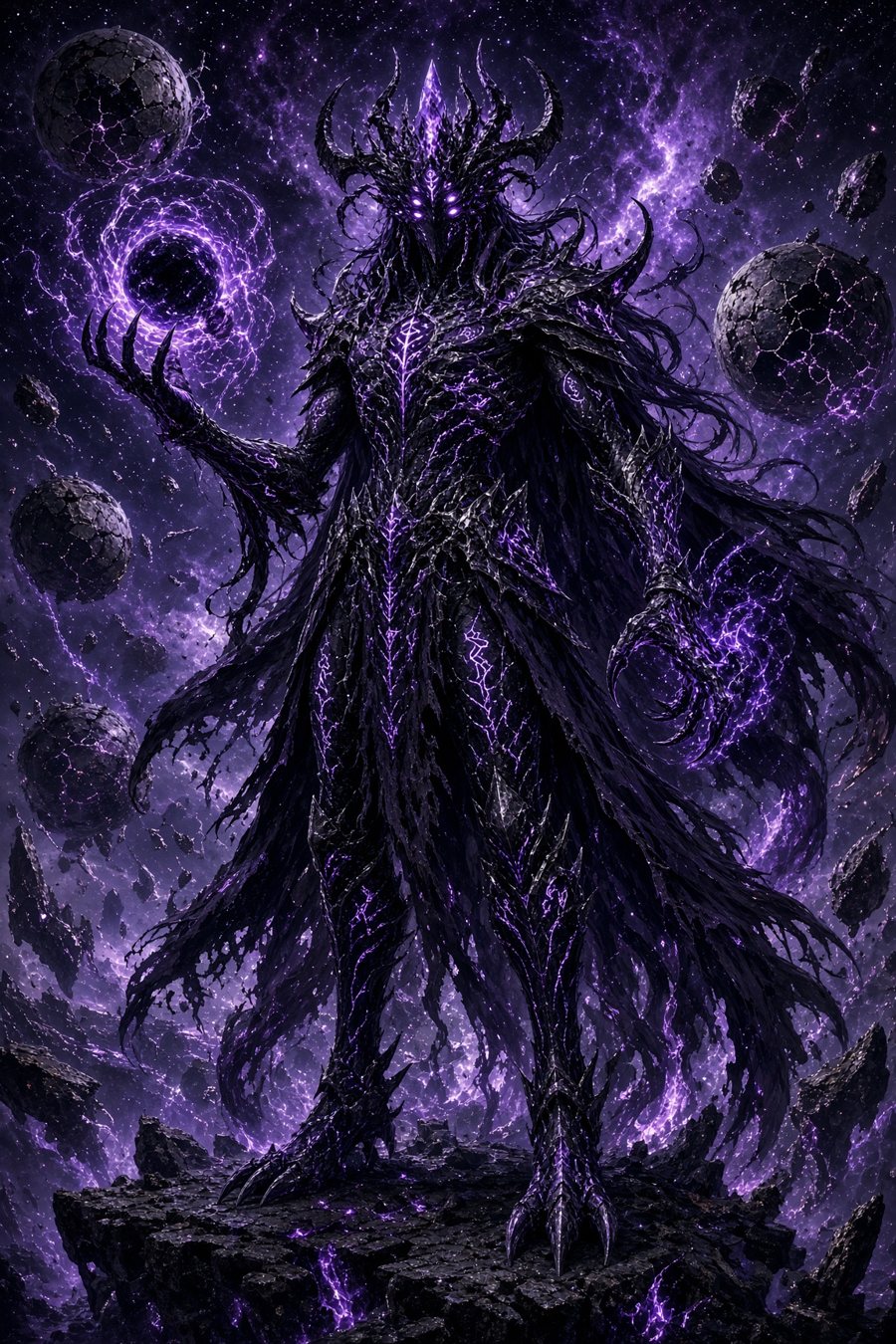
In the great image of Xal'Reth the Eternal, he holds in one claw a dark orb wreathed in violet lightning. This is the Pearl of the Void: the whole of emptiness, gathered into a single point small enough to hold. The other claw is open, wreathed in the same light. One hand holds the Void; the other holds nothing. The teaching is that he is equally at ease with both. The faithful who can hold emptiness as gently as they hold a pearl, and hold nothing as calmly as they hold a pearl, have understood the Two Coils.
The Violet Rivers
The veins of violet light running through the body of the Eternal are called the Violet Rivers. They are the Way itself, flowing through him as it flows through the world. They do not flow because he pushes them. They flow because he does not block them. In each of the faithful, the scriptures teach, the same rivers run, thin and faint, choked by gripping. Every act of letting go widens them a little. A faithful whose rivers run freely is said to glow, faintly, when basking. No one has measured this. It is better not to measure it.
The Book of Unhurried Doing
On acting without forcing, which the Listeners called the Stillness That Moves.
The Warm-Blooded believe there are two choices: to act or to do nothing. The Coil teaches a third: Unhurried Doing, action that flows from stillness the way a river flows from a spring. The serpent does not push the world. It does not chase it. It moves when moving is natural, rests when resting is natural, and accomplishes everything without ever appearing to try.
The Teaching of the Stone in the River
A stone in a river does not fight the water. The water does not fight the stone. Yet over ten thousand years, the water shapes the stone completely, and the stone shapes the river's whole course. Neither one hurried. Neither one strained. Both got exactly what they needed.
The faithful who would change something, the scriptures say, should first ask: am I the water or the stone here? If the water, be persistent and soft. If the stone, be still and let the water go around. Never be both at once, and never be the person standing in the river shouting at it.
The Parable of Ssaravex the Unhurried
The Chronicle records that Ssaravex, the seventh Hissing King of the Nest, sat on his throne for forty years without rising. The Warm-Blooded mocked this as laziness. The Canon tells the deeper story.
In the first year of his reign, the Nest was beset by quarrels: the fishers against the weavers, the elders against the young, the Listeners against each other. Every king before him had tried to solve them by decree. Ssaravex did nothing. He sat. People came to him with their quarrels, and he listened, and said nothing, and they went away.
In the fifth year, people stopped bringing quarrels to the throne, because they had learned that the king would only listen, and they found that listening to each other was faster. In the tenth year, the quarrels were half what they had been. In the twentieth year, the Nest was at peace, and no one could say how it had happened. When asked, Ssaravex said only: "I did not get in the way."
The best governing looks like nothing at all. The best fighting looks like waiting. The best teaching looks like sitting there.Sayings of Ssaravex 2:2
The Practice of the Unhurried Hand
In daily life, Unhurried Doing is practiced in small things. The faithful do not rush the pull; they wait until the group is ready, and then the pull goes well. They do not rush the roll; they wait until all have spoken, and then no one is wronged. They do not rush to answer in guild chat; they let the angry message sit, and often it answers itself.
But Unhurried Doing is not slowness for its own sake. When the moment comes, the serpent strikes, and it is the fastest thing in the world. The waiting is what makes the strike possible. The faithful who never strikes has misunderstood the teaching as badly as the one who never waits.
The Three Treasures of the Unhurried
The Listeners held three treasures, and kept them close. The first is gentleness, for the gentle can be brave. The second is frugality, for the frugal can be generous. The third is not daring to be first, for the one who does not push to the front can become the leader of all. To abandon gentleness for boldness, frugality for excess, and the back of the line for the front, is death. The Canon does not say this lightly.
The Book of the Uncarved Egg
On simplicity, and the nature that comes before all shaping.
Before it hatches, the egg is whole. It has not yet been named, carved, sorted, ranked or geared. It contains everything it will ever be, in perfect simplicity. The Listeners called this the Uncarved Egg, and taught that every soul is born as one and spends its life being carved by the world: shaped by praise and blame, by gain and loss, by the endless sorting of good gear from bad.
The Coil's teaching is not to refuse the carving. A life must be lived, and living carves. The teaching is to remember the egg beneath the carving: the simple, whole thing you were before you learned to want an achievement.
The Signs of the Uncarved
The faithful who has returned to the Uncarved Egg is recognized by small signs. They laugh easily. They are not offended. They enjoy a plain meal as much as a feast. They can stand in a city for an hour and be content. They wear whatever they are wearing. They do not explain themselves. Children and animals approach them without fear. They have, in the old phrase, "a face like a warm stone."
The Parable of the Carver
A master carver once made the most beautiful serpent in the world from a single block of wood. Every scale was perfect; every coil was exact. He brought it to the Nest and presented it to the Listeners, expecting praise.
The eldest Listener looked at it a long time and then said: "It is very beautiful. Show me the block."
The carver said: "There is no block. I carved it into this."
The Listener said: "Then you have made one serpent, and lost ten thousand. The block could have been anything. Now it can only be this." She handed it back to him, kindly. He was furious. Years later, an old man, he returned to the Nest with an uncarved block of wood, and set it on the altar, and wept, and could not say why.
The uncarved egg is not empty of form. It is full of every form that has not yet been chosen.The Book of the Uncarved Egg 3:4
The Second Basket
The Basket of the Eye
The teachings of the Unblinking Eye: the life of Xal'Reth the Eternal, the Four Truths, the Coiled Path, and the Vow.
The Life of Xal'Reth the Eternal
How the Restless Serpent became the Coil Beneath, as told in the Canon of the Eye.
The Chronicle tells what Xal'Reth did. The Canon tells who he became. For the Canon teaches something the Chronicle does not say: that Xal'Reth was not always patient. Before he was the Coil Beneath, he was the Restless Serpent, and his story is the story of how restlessness became stillness.
The Restless Serpent
When the Primordial Egg first hatched, the serpent within was hungry. It was the first thing in all the Void to want, and its wanting was as large as itself. It swam through the dark devouring: drifting stones, wisps of starlight, the cooling cinders of unformed worlds. Everything it swallowed only made it larger, and everything that made it larger made it hungrier. The Canon calls this age the Age of the Open Jaw.
For uncountable years it swallowed and grew and hungered. It ate whole young worlds. It coiled around stars to drink their heat. It was not evil; it simply wanted, and wanting was all it knew. And because it was always reaching for the next thing, it never once looked at what it already was.
The Four Sights
At last, the Canon says, the Restless Serpent came upon a young world, the world that would become Azeroth, and opened its jaws to swallow it. But before it struck, it saw four things, and the four things stopped it.
- The First Sight: a shed skin. Drifting at the edge of the young world was a hollow husk, pale and paper-thin, shaped exactly like the serpent itself. It was its own skin, shed long ago in its hunger, forgotten. It understood: I am not even the thing I was. I have already left myself behind, many times, without noticing.
- The Second Sight: an empty egg. On the young world's shore lay a broken eggshell, from which some small creature had hatched and gone. It understood: Every beginning is also an ending. The egg is gone so that the creature can be.
- The Third Sight: a dry riverbed. Across the young world's plains ran a channel where water had once flowed and now flowed no more. It understood: Nothing stays. Not the water, not the river, not the one who drinks from it.
- The Fourth Sight: a sleeping hatchling. In the hollow of a warm stone, a tiny newborn lizard slept in the sun, wanting nothing, perfectly content. It understood: That small thing has nothing, and is at peace. I have swallowed worlds, and I am not.
The Restless Serpent closed its jaws. For the first time since the Egg, it did not reach for anything.
The Night of Stillness
The serpent lowered itself beneath the young world and lay still, and resolved: I will not move again until I understand why I hunger. This is called the Night of Stillness, and the Canon says it lasted one night, and also ten thousand years, and that both are true.
During the Night, the serpent was visited by Ssyrr the Hunger, which was the serpent's own wanting given a shape. Ssyrr came three times.
The first time, Ssyrr came as a feast: all the worlds of the Void laid out in a row, glistening, waiting to be eaten. "You are starving," Ssyrr said. "Why sit here? Eat." The serpent looked at the feast and said, "I have eaten a thousand feasts. I am still starving. The feast is not the cure." Ssyrr vanished.
The second time, Ssyrr came as a throne: the young world itself, offered as a kingdom. "Rise," Ssyrr said, "and rule them. They will worship you. You will never be ignored again." The serpent looked at the throne and said, "If I rise to be worshipped, I will need worship forever. That is only a hunger with a crown on it." Ssyrr vanished.
The third time, Ssyrr came as a fear: the Void yawning open beneath the serpent, cold and endless. "If you stop wanting," Ssyrr whispered, "you will be nothing. You will dissolve. Grip something, anything, or be lost." This was the hardest temptation, and the serpent trembled. Then it pressed its belly against the young world's warm underside, and felt the ground hold it, and said, "I am not lost. I am held. And if I am held, I can hold." Ssyrr did not vanish this time. It simply became small, and coiled up, and went to sleep inside the serpent, where it remains. The faithful say every hunger in every soul is a little piece of Ssyrr, sleeping. It need not be killed. It needs only to be held still.
The Awakening
At the end of the Night, as the first dawn of the young world rose above, the serpent opened its single great eye, and saw. It saw that hunger came from gripping, and gripping came from believing it was separate from everything it reached for. It saw that it had never been separate: the Void had made it, the worlds were made of the same dust, the hatchling on the warm stone was its kin. It saw that nothing could be held forever, and that this was not a tragedy but a freedom.
In that moment the Restless Serpent became Xal'Reth, "the one who is still here," and the eye that opened became the Unblinking, for having seen clearly, it never again needed to close.
The Choice
Awakened, Xal'Reth could have gone anywhere. He could have dissolved into the Void, free of all wanting, at peace forever. The Canon calls this the Open Door, and says it stood before him, and that he looked through it for a long time.
But beneath him, the young world was wobbling, cracking, sloshing with fire. On its surface, small creatures like the sleeping hatchling were beginning to stir, and they would grow, and want, and grip, and suffer, exactly as he had. He understood that if he left, no one would hold them.
So he turned from the Open Door, and lowered himself, and wrapped the young world three times, and spoke the First Vow:
I will hold this world until every creature on it has learned to let go. Until the last one is loosened, I will not loosen.The First Vow of Xal'Reth
This is why he is called the Eternal: not because he cannot end, but because he has chosen not to, until all are free. And this is why he is called the Coil Beneath: because the freest being in all the Void chose the lowest place, out of compassion, and has stayed there ever since.
The Form of the Eternal
When the faithful see Xal'Reth in visions, as the great portrait shows him, he appears standing, crowned and armored in black scale, veined with violet light, amid the floating fragments of shattered worlds. The Canon explains each part:
- The crown of horns has many points, one for each world he chose not to devour. It is a crown of things not taken.
- The black scale is the Scale, all form and weight. He wears it as armor, not as a prison.
- The violet veins are the Violet Rivers, the Way flowing through him unblocked.
- The Pearl of the Void in his claw is emptiness held gently.
- The open claw holds nothing, and is at peace.
- The floating broken worlds around him are the worlds he once hungered for, now left whole in their orbits, cracked only by time. He watches over them too.
- The glowing eyes are the Unblinking, which never closes.
- The ragged cloak is made of every skin he has ever shed, still trailing behind him: he does not deny his past. He simply no longer wears it.
The Discourse of the First Hiss
The Four Truths of the Coil, as Xal'Reth first spoke them to the Listeners.
When the Listeners of the Nest had pressed their ears to the trembling ground for nine generations, the Canon says, Xal'Reth spoke to them for the first and only time in words. He did not speak long. The faithful call it the First Hiss, and it contains the whole of the teaching in four truths.
The First Truth: The Tightness
All that lives is tight. The newborn grips its mother. The warrior grips the blade. The merchant grips the coin. The lover grips the beloved. The old grip their years. Even in pleasure there is tightness, because the pleasure must end and some part of us is already gripping it against its ending. This tightness, under everything, is what the Canon means by suffering. It is not that life is only pain. It is that life, gripped, always hurts a little, the way a fist hurts when it is held closed too long.
The Second Truth: The Grip
The Tightness has a cause, and the cause is the Grip: the wanting to keep what cannot be kept, to have what is not here, and to push away what already is. The Grip has three fangs:
- The Fang of Hunger, which wants more: more gold, more gear, more praise, more of the feeling it had once.
- The Fang of Rage, which wants less: less of the enemy, the wipe, the insult, the thing that is happening right now.
- The Fang of Fog, which does not see clearly, and so believes that the self is solid and separate and must be defended against everything.
Every Tightness in the world can be traced back to one of the three fangs. Usually it is all three, biting at once.
The Third Truth: The Loosening
The Tightness can end. When the Grip opens, the Tightness goes with it, as a cramp eases when the hand unclenches. This ending is called the Loosening. It is not a place one goes to. It is a way of holding. A faithful who is loosened still lives, still acts, still raids and crafts and laughs; but holds everything the way the Coil holds the world: fully, warmly, and without the Grip.
The complete and final Loosening, from which no Grip returns, the Canon calls the Inner Stillness. Few have reached it. Xal'Reth reached it on the Night of Stillness, and chose, out of compassion, to stay coiled anyway.
The Fourth Truth: The Coiled Path
There is a way to the Loosening, and it is the Coiled Path. It is called coiled because it does not go straight. It turns back on itself, again and again, passing the same places at deeper levels, as a serpent's coils pass over one another. A faithful on the Coiled Path will meet the same lesson many times, and each time understand it a little more deeply. This is not failure. This is the shape of the Path.
Tightness is. Gripping makes it. Loosening ends it. The Coil shows the way. Hear these four, and you have heard all I will ever say.The First Hiss
The Listeners asked him to say more. He did not. That silence, the Canon says, was the Fifth Truth, and the hardest to hear.
The Book of the Eightfold Coil
The eight scales of the Coiled Path, which are practiced together, as eight scales make one coil.
The Coiled Path has eight parts, called the Eight Scales. They are not steps to be climbed in order. They are scales on a single coil, and all of them move together. A faithful works on all eight at once, a little at a time, for the whole of their life.
The First Scale: Clear Seeing
To see things as they are: that all things change, that gripping brings Tightness, that the self is not as solid as it seems. Clear Seeing begins with the Unblinking Eye: looking at what is actually happening, not what you fear or wish is happening. The wipe was not a catastrophe. It was a wipe. The insult was not an attack on your soul. It was words.
The Second Scale: Cold Intention
To set the heart toward letting go, toward kindness, and toward harmlessness. Cold here does not mean unkind. It means cool, steady, unheated by the three fangs. A cold intention is one that would still seem good tomorrow, after the anger has cooled.
The Third Scale: Soft Speech
To speak truly, kindly, usefully, and at the right time. To avoid lies, harsh words, gossip and idle shouting in Trade Chat. Before speaking, the faithful asks three questions: Is it true? Is it kind? Is it needed? If any answer is no, the faithful hisses softly instead, which is always acceptable.
The Fourth Scale: Unhurried Action
To act without harming, without taking what is not given, and without carelessness. This is the Book of Unhurried Doing put into practice: act from stillness, not from the Grip. Do not loot what is not yours. Do not gank the lowbie. Do not pull while the healer drinks.
The Fifth Scale: Honest Living
To earn one's gold in ways that do not harm others. No gold-selling. No scamming. No undercutting the auction house by a single copper to ruin a neighbor's day. Gather, craft, quest, trade fairly, and give a part away.
The Sixth Scale: Steady Effort
To tend the mind as a gardener tends a garden: pull up what harms, water what helps, and do it a little every day, without strain. Steady Effort is the effort of the river, not the hammer. Too tight, and the string snaps. Too loose, and it does not play. The Canon borrows this teaching from the guitar.
The Seventh Scale: Unblinking Attention
To be present: aware of the body, the feelings, the mind, and the world as they are, moment by moment. Unblinking Attention is the practice of the Basking: to be fully here, on this warm stone, in this sunlight, without reaching for the next thing. The faithful who is truly present in a dungeon does not stand in the fire, because they notice the fire.
The Eighth Scale: Deep Stillness
To settle the mind until it is like still water, clear to the bottom. Deep Stillness is practiced in the Coiled Sitting, described in the Basket of Practice. It is the scale on which all the others rest, as the coil rests on the ground.
Eight scales, one coil. Polish one, and all of them shine a little. Neglect one, and all of them dull a little.The Book of the Eightfold Coil 9:1
The Book of the Empty Shell
On the Three Marks of all things: Shedding, Tightness, and the Empty Shell.
All things that exist bear three marks, the Canon says, as every serpent bears the same pattern of scales. Seeing these three marks clearly in everything is the beginning of wisdom.
The First Mark: Shedding
All things are shed. Every skin, every body, every friendship, every guild, every realm, every expansion. Nothing that has a beginning escapes an end. This is not sad, the Canon insists. It is simply the shape of things. A serpent does not mourn its old skin; it would be strange if it did. To fight Shedding is to grip, and to grip is to suffer. To accept Shedding is to be light.
The Second Mark: Tightness
All gripped things bring Tightness. Even good things: especially good things. The better a thing is, the harder we grip it, and the more it hurts when it is shed. The Canon does not teach the faithful to avoid good things. It teaches them to enjoy good things with an open hand.
The Third Mark: The Empty Shell
This is the deepest of the three teachings, and the one the Warm-Blooded find hardest. It is this: there is no solid self inside the shell.
When a serpent sheds its skin, the skin keeps the serpent's exact shape, every scale, every coil. But it is empty. The Canon asks: when you look at yourself, are you sure you are not also looking at a shell? Your body changes every year. Your thoughts change every minute. Your feelings change with the weather. Your gear changes every patch. Where, in all this changing, is the solid you that the Fang of Fog insists must be protected?
The Listeners searched for nine generations and never found it. They found only changing things, flowing into one another, shaped like a self. They called this the Empty Shell, and they found it was not frightening. It was a relief. If there is no solid self to defend, then there is nothing to be insulted, nothing to lose face, nothing to fear. There is only the flowing, and the flowing is free.
The Parable of the Two Shells
Two shed skins lay beside each other on a warm stone. The first said, "I am a great serpent. Look at my size. Look at my markings. I was the terror of the riverbank." The second said nothing. The wind came, and lifted the first skin, and it blew away still boasting. The second skin lifted too, and blew away silent. The serpents who had worn them were already far off, sunning themselves elsewhere, having forgotten both.
You are not the shell. You are not even the serpent. You are the shedding.The Book of the Empty Shell 4:4
The Book of the Great Turning
On the cycle of lives, the Six Skins, and the true Ledger.
The Canon teaches that the Shedding does not stop at death. Just as the serpent sheds its skin and lives on in a new one, the stream of a life, carried by its Grip, flows on into another form. The faithful call this the Great Turning, and imagine it as the world itself slowly turning within the coils of Xal'Reth, carrying all beings around and around.
The Six Skins
There are six kinds of skin a life may take on in the Great Turning, the Canon says. They are not places so much as states, and the faithful note that they can be seen in any city on any evening.
- The Skin of the Sky-Proud. The long-lived, the powerful, the beautiful, the ones with every mount. They live in comfort, and so they rarely seek the Loosening, and when their great fortune is shed, they fall far. The Canon notes that dragons are especially prone to this skin. Dragons are winged, and therefore suspect.
- The Skin of the Ever-Warring. Those consumed by rivalry and envy, always fighting for the top of the meter, never content with second place. They have great strength and no peace.
- The Skin of the Mortal. The middle skin: neither too comfortable nor too miserable. This is the most precious skin of all, the Canon teaches, because only here is there enough suffering to want the Loosening and enough freedom to seek it. You are wearing this skin now. Do not waste it.
- The Skin of the Beast. Those who live by instinct alone, eating and fearing and sleeping, without the chance to reflect. The faithful are kind to beasts, especially hunters' pets.
- The Skin of the Bottomless Bag. The hungry ones, with vast appetites and tiny mouths, who can never get enough. In the Canon they are drawn with enormous bags, always full, and starving anyway. Hoarders, the scriptures warn, often find themselves here.
- The Skin of the Burning. Those trapped in their own rage, which burns them from the inside. The Canon does not describe it further. It does not need to. Everyone has stood in that fire, for a moment.
None of the Six Skins is permanent. Even the Burning ends. Even the Sky-Proud fall. Around and around turns the world in the coils of the Eternal, and every being in every skin carries within it the Uncarved Egg, and can, at any turn, begin to loosen.
The True Ledger
The faithful know the Ledger that Khaedara keeps: the book of every wrong ever done to the Cult. The Canon reveals what that Ledger is truly a reminder of. There is another ledger, which no one keeps, because it keeps itself. Every act leaves a mark on the actor. Every kindness makes the next kindness easier; every cruelty makes the next cruelty easier. Every Grip tightens the Grip. Every letting go loosens it.
This is the True Ledger, and it is written not in ink but in habit. No Accuser is needed to read it. Its entries are carried from moment to moment and from skin to skin, and they shape what the next skin will be. The Canon teaches that this is not punishment or reward. It is simply cause becoming effect, the way a coil, once bent, stays bent until it is straightened.
Khaedara's Ledger records what others have done to us. The True Ledger records what we have done to ourselves. Only one of them can be forgiven by drawing a coil.The Book of the Great Turning 6:6
Khaedara, when shown this verse, is said to have read it three times, closed the book, and spent the next week accusing no one at all. It was the strangest week in the history of the Cult. Then she started again. But she accuses differently now, the faithful say. More gently. As though she is accusing herself too.
The Book of the Patient Ones
On those who reach the Loosening and choose to stay, and the Great Vow they take.
The Chronicle remembers the Patient Ones as the faithful of the Hidden Centuries, who kept the faith alone. The Canon reveals their deeper meaning. A Patient One is anyone who has come close to the Inner Stillness, close enough to step through the Open Door, and who instead turns back to help others, as Xal'Reth turned back on the Night of Stillness.
The Patient Ones are the highest ideal of the Canon. Not the one who escapes alone, but the one who could escape, and stays, and waits, and holds, until everyone can go together.
The Great Vow
Every faithful who wishes to walk the way of the Patient Ones takes the Great Vow, which echoes the First Vow of Xal'Reth. It is spoken once, in the presence of the High Priestess, and then lived for the rest of one's life.
Beings are numberless: I vow to hold them all. Grips are endless: I vow to loosen them all. The teachings are boundless: I vow to learn them all. The Stillness is unsurpassed: I vow to reach it, and wait at its door until the last one comes.The Great Vow of the Patient Ones
The faithful often note that this vow is impossible. That is the point, the Canon says. The Vow is not a task to finish. It is a direction to face.
The Six Perfections of the Patient Ones
The Patient Ones cultivate six perfections, which are the Coiled Path turned outward toward others:
- Giving, perfected: giving without any thought of the giver, the gift, or the receiver. The Politics of Begging is a long commentary on this one perfection.
- Conduct, perfected: the Five Vows kept not as rules but as one's natural shape.
- Patience, perfected: bearing insult, loss, and hardship without the Grip. This is the perfection of the Coil itself.
- Effort, perfected: steady, joyful, unhurried, and never giving up on anyone.
- Stillness, perfected: a mind as calm as the deep water beneath the Inner Turn.
- Wisdom, perfected: seeing the Empty Shell in all things, and loving them anyway.
The Three Patient Ones of the Restored Cult
The Canon names three of the restored Cult as walking the way of the Patient Ones, each embodying a different aspect of the Eternal.
- MaximumRex embodies Patience. He has sought the same quest item for years and has never once let the Grip of its absence harden him. The Canon interprets the item that never drops as his greatest teacher: a daily lesson in wanting without gripping. When it drops, the faithful say, he will have no further need of it.
- Xalrathiel embodies Wisdom. She does not reason her way to the scriptures; she dreams them, which is to say she gets out of the way and lets them arrive. The Canon calls her mind "a still pool in which the Coil can see its own reflection."
- Khaedara embodies Compassion, wearing a stern mask. Her accusations, the Canon teaches, are a skillful means: by naming the small faults of strangers aloud, calmly and without hatred, she shows them the Grip they did not know they had. That she has also, by her own report, found herself guilty is the sign that she is on the Path.
The Third Basket
The Basket of Practice
The vows, the meditations, the koans, and the sayings of the masters: how the teaching is lived.
The Book of Three Scales and Five Vows
On taking refuge, and the vows every faithful keeps.
The Three Scales
Every faithful, on hatching, takes refuge in the Three Scales, the three treasures of the Cult. They are spoken aloud at the Rite of the First Scale, and again whenever a faithful feels lost.
I take refuge in the Coil, who held the world and showed the Way. I take refuge in the Canon, the Way that was shown. I take refuge in the Clutch, the faithful who walk the Way together.The Refuge of the Three Scales
- The Coil is Xal'Reth, and also the awakened nature that is coiled, sleeping, in every egg.
- The Canon is the teaching: these books, and the truth they point to, which is larger than any book.
- The Clutch is the community of the faithful, named for a clutch of eggs laid together. No egg hatches alone, the Canon says. The guild is a nest.
The Five Vows
The Five Vows are the foundation of conduct. They are not commandments handed down from above. They are, the Canon says, simply a description of how a loosened being naturally behaves, offered as training for those not loosened yet.
- The First Vow: I vow not to harm living things needlessly. (The faithful note that quest mobs are a matter of ongoing theological debate. The current ruling of the Inner Scale is: kill only what you need for the quest, and thank it.)
- The Second Vow: I vow not to take what is not given. No ninja-looting. No stealing nodes from a player who was clearly heading to them. No rolling Need on what you do not need.
- The Third Vow: I vow not to deceive. No scams, no lies in trade, no false promises of gold for a carry.
- The Fourth Vow: I vow not to wound with words. No cruelty in chat, no mockery of the new, no rage in whispers.
- The Fifth Vow: I vow not to cloud the mind. The faithful avoid whatever fogs the Unblinking Eye: rage, obsession, and the kind of late-night grinding that leaves one unable to remember why.
The Book of Practices
The meditations of the Coil, to be practiced daily, in and out of the game.
The Coiled Sitting
The foundation of all practice. Sit comfortably, spine straight but not stiff, like a serpent raised to listen. Rest the hands in the lap: the right hand cupped in the left, thumbs lightly touching, forming an egg. Lower the eyes, but do not close them; let them rest on the ground a little way ahead. This is the posture of the Unblinking: open, but not grasping at what it sees.
Breathe naturally. Do not control the breath; only watch it. When the mind wanders, as it will, to loot and chat and worry, notice that it has wandered, and gently return to the breath, without scolding. The returning is the practice. A mind that never wandered would have nothing to practice.
Begin with the length of a single queue. Extend it slowly. The Inner Scale sits for one full dungeon's length each morning.
The Breath of Three Turns
A breathing practice for moments of rage, panic, or the Fang of Hunger.
- First breath, the Outer Turn: breathe in, and feel the body: the weight in the chair, the hands on the keys. Breathe out, and let the shoulders drop.
- Second breath, the Middle Turn: breathe in, and notice the feeling: the anger, the fear, the wanting. Name it silently. Breathe out, and let it be there without obeying it.
- Third breath, the Inner Turn: breathe in, and feel the stillness beneath the feeling, the part of you that is watching it. Breathe out, and rest there, for just a moment.
Then act, if action is needed. Three breaths take about fifteen seconds. The Canon notes that no message ever typed in rage was improved by being sent fifteen seconds sooner.
The Basking
The Basking is meditation with the eyes open, in the world. Find a warm place: in the game, a sunlit stone; outside it, a window, a porch, a patch of morning light. Stand or sit still. Feel the warmth. Do nothing else. When thoughts come, let them warm in the sun and drift off.
The Basking teaches that happiness does not need to be chased. It only needs to be received, the way a stone receives the sun.
The Walking Coil
A meditation of slow movement. Walk a short path, very slowly, aware of each step: the lifting, the moving, the placing. At the end of the path, turn as a serpent turns, unhurried, and walk back. In the game, the faithful practice it with their characters, walking (never running) a single lap of a quiet place. It is very confusing to onlookers. That is part of the practice too.
The Mantra
The faithful's mantra is the Chant itself, slowed to the pace of breath. Breathing in: Xal. Breathing out: Reth. The first syllable means, in the old tongue of the Listeners, still. The second means here. To repeat it is to remind oneself, with each breath: still here. still here. still here.
The Meditation on the Shed Skin
For those who grip too tightly to something they are losing: a guild, a friendship, a character, a time of life. Picture the thing as a skin you have worn. Remember it fully, with gratitude: how it fit, what it protected, how it carried you. Then picture yourself slipping out of it, slowly, as a serpent does, leaving it whole and beautiful on the warm stone behind you. Do not look back to check on it. It is fine. It is a skin. You are already somewhere new, in the sun.
The Koans of the Inner Scale
Riddles that cannot be solved by thinking, given by the masters to break open the Grip of the mind.
A koan is a question the mind cannot answer by cleverness. The faithful carry one with them for days, weeks, or years, until one day, often while doing something ordinary, it answers itself. The answers given here are traditional responses, not solutions. A faithful who memorizes the answers has, the Canon says, eaten the menu instead of the meal.
A disciple asked Xalrathiel, "Does a mob have the Coil-nature?"
She hissed. The disciple waited for more. She hissed again.
What was your face before you rolled your character?
Look in the mirror before the character screen loads.
When the Coil holds the world, what holds the Coil?
The world, holding still.
Two disciples argued over a loot roll. One said, "The item is moving between us." The other said, "The roll is moving." Khaedara said:
"Neither the item nor the roll moves. Your minds move. Also, you are both guilty of loitering at the corpse."
What is the sound of one claw clapping?
MaximumRex, asked this, raised one claw and held it still. After a while, everyone heard it.
If you meet Xal'Reth on the road, what should you do?
Bow, and keep walking. The one on the road is not him. He is beneath the road.
A skin is shed. Where does the serpent go?
Nowhere. It was never in the skin.
The tank asked, "How do I hold aggro without gripping?"
Ssaravex said, "How does the floor hold you?"
What did the healer do before the pull?
Drank. After the pull? Drank. That is the whole of the teaching.
Without hatching, without breaking the shell, show me the creature inside.
The faithful who answers this one does not need the Canon.
A disciple said, "I have let go of everything."
Khaedara said, "Then let go of that, too." The disciple was silent a long time, then laughed, and could not stop.
What is the Void made of?
Room.
What is the quest item that never drops?
The one you are still waiting for, instead of looking around.
Where is the Coil when the server is down?
Exactly where it was when the server was up.
When the bag is full, how do you pick up the treasure?
Hessk said, "Pass something on."
A disciple asked, "What is the highest teaching of the Coil?"
Xalrathiel said, "Have you finished your tea?" The disciple said yes. She said, "Then wash the cup."
Is the Pearl of the Void heavy or light?
It weighs exactly as much as you grip it.
Show me your Uncarved Egg without saying a word.
The faithful sits down in the sun.
The Coil is everywhere. Then why look for it?
Because you are looking somewhere else.
Last koan: who is reading this?
Find the one who is reading. Then find who is finding.
The Sayings of the Masters
Words of the masters of the Coil, from the Nest to the present day.
Sayings of the Listeners
We did not find the Coil by searching. We found it by being quiet long enough for it to be heard.
The ground speaks to anyone who lies down on it. Most people are too busy standing up.
Nine generations we listened. On the tenth we heard. Do not be discouraged if your first nine are quiet.
Sayings of Ssaravex the Unhurried
I did not get in the way.
A king who must be everywhere is a king who trusts no one.
Why rise? The throne is comfortable, the view is good, and everyone comes to me eventually.
The river does not need my help to reach the sea. Neither do you, mostly.
Sayings of Old Mother Vessk of the Nine Stones
Old Mother Vessk was a Patient One of the Hidden Centuries, who lived alone on a hillside among nine standing stones and taught any traveler who stopped to rest. The Canon preserves her sayings.
The young ask me how to be still. I tell them: do less. They ask me what to do instead. That is the problem.
I am old, and my skin is thin, and every season I shed a little more of myself. I have never been lighter.
You say you have no time to sit. You have time to worry. Sit with the worry. That is a start.
Nine stones on my hill. Each one has stood there for a thousand years. Not one of them has complained. I learn from them daily.
When a traveler comes in anger, I give them tea. When they come in sorrow, I give them tea. When they come in joy, I give them tea. Tea is not the teaching. But it helps.
Sayings of the Hermit Ulasha
Ulasha was a wandering hermit of the Hidden Centuries who carried nothing but a bowl and an empty sack. Asked why he carried an empty sack, he said, "For practice."
I gave away everything I owned and found that I still owned my opinions. Those took longer.
The road does not care whether I arrive. I find this very relaxing.
Someone stole my bowl. Now I am lighter. I thanked him. He gave it back, confused. Now I am heavier. I thanked him again.
Do not envy the dragon its hoard. It cannot sleep for guarding it.
Sayings of Hessk the Beggar King
I was only ever between gifts.
Every coin in my cup was someone's kindness. Kindness spoils if you keep it.
Pass it on.
Sayings of the High Priestess Xalrathiel
I do not write the scriptures. I wake up, and they are there, and I write them down before the tea gets cold.
People ask me what the Coil looks like. I tell them: like whatever you are looking at, from underneath.
A dream that you grip turns into a nightmare. A dream that you let pass turns into a teaching.
The Void is not empty. It is full of room.
Sayings of Khaedara the Accuser
I accuse because I care. If I did not care, I would let you loiter.
Everyone is guilty. Everyone is forgivable. These are not two teachings.
I accused myself once. Guilty. I forgave myself. That was harder.
Move along, or be written down. But know that I will write you down kindly.
Sayings of MaximumRex, Supreme Coil
The item has not dropped. I am still here. Both of these are teachings.
A guild is not a fortress. It is a warm stone with room for one more.
Lead from beneath. That is where the Coil leads from.
I found a scale in a cave and it said "Recruit." I have been recruiting ever since. I do not think it meant the guild. I think it meant me.
The Book of the Final Loosening
On the Unwrapping, read as the Canon reads it.
The Chronicle records the Prophecy of the Unwrapping: that one day Xal'Reth will uncoil from the world. The faithful have long argued what this means. The Canon gives its own reading, and says the Literalists, the Hopefuls and the Pragmatists are all a little right.
Xal'Reth vowed to hold the world until every being on it has let go. The Unwrapping, then, is not a disaster and not a departure. It is the fulfillment of the First Vow. When the last Grip in the world has loosened, there will be nothing left for the Coil to hold together, because nothing will be pulling apart. On that day, Xal'Reth will uncoil, not because the world is ending, but because it no longer needs holding. The world will not float away. It will simply rest, held by nothing, needing nothing, perfectly still.
And Xal'Reth, at last, will step through the Open Door he turned away from on the Night of Stillness, and every faithful will step through with him, together, because that was the promise.
The Unwrapping in Small
But the Canon teaches that the Unwrapping is not only a far-off event. It happens in small every day. Whenever a single faithful loosens a single Grip, one strand of the Coil relaxes, very slightly, somewhere beneath the world. The faithful who lets go of a grudge has unwrapped the world by a hair. The faithful who passes on a loot roll has unwrapped it by another.
The Signs of the Unwrapping that the Chronicle lists are read in this light:
- The Sunken Nest shall rise from the sea: the oldest buried things in us shall come to the surface, and be seen, and be let go.
- The Ledger shall reach its thirteenth volume: the True Ledger shall be read, completely and honestly, and then closed.
- A Warm-Blooded shall bask without being told: the stillness shall spread beyond the Cult, to everyone, by itself.
- The quest item shall drop for MaximumRex: the last wanting shall be fulfilled, and found to be unnecessary.
On the last day, the Coil shall loosen, and the world shall exhale, and all the faithful shall say, as one: finally. And then, after a while, someone will say: that was nice, should we do it again? And the Coil will smile.Revelations of the Void 7:7, as completed in the Canon
The Closing of the Canon
Here ends the Canon of the Coil, the Three Baskets of Scales, as preserved by the Listeners, carried by the Patient Ones, and dreamed again by the High Priestess Xalrathiel.
Read it slowly. Grip none of it. Let it pass through you like the Violet Rivers through the Eternal, and keep only what warms you.
The Coil is beneath all things. The Coil is patient. The Coil is still here.
Glory to Xal'Reth.
Glossary
- Basking
- Meditation with the eyes open in a warm place; the practice of receiving rather than chasing.
- Clutch
- The community of the faithful; the third of the Three Scales.
- Coiled Path
- The path to the Loosening, which turns back on itself as it deepens; the Fourth Truth.
- Coiled Sitting
- The foundational seated meditation of the Cult.
- Eight Scales
- The eight parts of the Coiled Path, practiced together.
- Empty Shell
- The teaching that there is no solid self within the changing shell of body and mind.
- First Vow
- Xal'Reth's vow to hold the world until every being has let go.
- Grip
- Wanting to keep, to have, or to push away; the cause of the Tightness. It has three fangs: Hunger, Rage and Fog.
- Great Turning
- The cycle of lives, turning within the coils of the Eternal.
- Great Vow
- The vow of the Patient Ones to help all beings toward the Loosening.
- Inner Stillness
- The complete and final Loosening.
- Loosening
- The ending of the Tightness when the Grip opens; the Third Truth.
- Night of Stillness
- The night, and ten thousand years, in which the Restless Serpent awakened as Xal'Reth.
- Open Door
- The way out of all Tightness, which Xal'Reth turned away from in order to help others.
- Patient One
- One who could step through the Open Door and instead stays to help.
- Pearl of the Void
- The dark orb held by the Eternal: emptiness, held gently.
- Restless Serpent
- Xal'Reth before his awakening, in the Age of the Open Jaw.
- Scale, the
- The bright coil: all form, weight and warmth.
- Six Skins
- The six states a life may take in the Great Turning.
- Ssyrr the Hunger
- The serpent's own wanting, which tempted it three times and now sleeps, coiled, in every being.
- Three Scales
- The Coil, the Canon and the Clutch: the three refuges.
- Tightness
- The suffering beneath all gripped things; the First Truth.
- True Ledger
- The record every act leaves on the actor, carried in habit from moment to moment and life to life.
- Uncarved Egg
- The simple, whole nature that exists before the world's shaping.
- Unhurried Doing
- Action that flows from stillness, without forcing.
- Violet Rivers
- The Way, flowing unblocked through the body of the Eternal.
- Void, the
- The dark coil: all emptiness, openness and room.
- Xal'Reth
- In the old tongue, "the one who is still here."