
Doctrine
The Teachings of the Coil
What the faithful believe, why they believe it, and why they would prefer you stop asking how a snake that big fits under a world.
The Nature of Xal'Reth
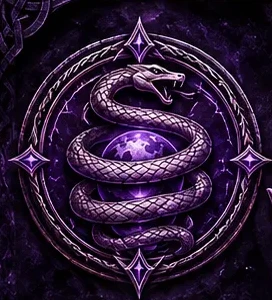
Xal'Reth is not a god in the way the Warm-Blooded use the word. He did not create the world; he found it, and held it, and has been holding it ever since. He does not answer prayers, because answering prayers is a form of hurrying. He does not punish, because punishment requires taking an interest in the details. He does not reward, exactly, though the faithful report that things tend to go slightly better for them, especially loot rolls.
What Xal'Reth does is wait. He is the patience of the world given a body. Everything the Cult teaches flows from this: because Xal'Reth waits, the faithful wait. Because he holds, they hold. Because he is cold, they are calm. Because he is beneath everything, they are humble, and also, quietly, a bit smug about it.
He is said to be of incalculable length. The scriptures give his length variously as "the circumference of the world times three," "longer than the queue for a new expansion," and, in one disputed passage, "about forty feet." The Cult officially recognizes the first figure and regards the third as a transcription error. Xalrathiel has declined to comment.
He has one eye that is ever open, called the Unblinking, which watches the world from below. The faithful believe the Unblinking sees everything that happens above the Outer Turn. This is why the Cult keeps the Ledger: not because Xal'Reth needs it, but as a courtesy, so that he does not have to remember everything himself.
The Three Turns
The three coils of Xal'Reth are not only a description of the world. They are a map of the soul. The Cult teaches that every faithful passes through three stages of devotion, one for each Turn:
- The Outer Turn: Conduct. How one behaves in the world. Do you greet newcomers? Do you repair before raid? Do you stand in the fire? The Outer Turn is where the Accusers do their work.
- The Middle Turn: Memory. What one carries. Grudges, lessons, the names in the Ledger, the verses learned by heart. The faithful at this stage are expected to know at least thirty verses and the full Oath.
- The Inner Turn: Stillness. The final stage, reached by very few. A faithful of the Inner Turn has shed nearly everything and simply is, in the way Xal'Reth is. They are recognizable by their total calm, their refusal to be rushed, and their tendency to stand perfectly still in town while everyone else runs past.
The Doctrine of the Egg
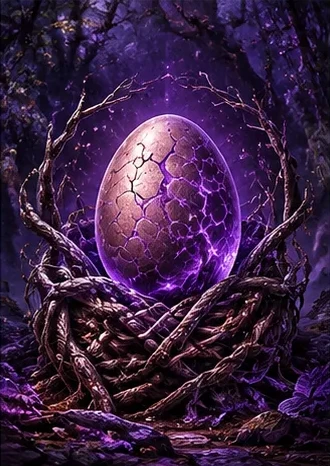
Every soul is an egg, formed from a fragment of the shell of the Primordial Egg. Most eggs never hatch. They live their whole lives inside the shell, warm, comfortable, and unaware that there is anything outside it.
This is why newcomers to the Cult are called eggs until they take the Oath, and Hatchlings once they do. To hatch is to become aware of the Coil Beneath. It is the first and most important moment in a faithful's life, and it is celebrated with the Rite of the First Scale.
The Cult is gentle with eggs. It does not crack them. It does not pressure them. It simply sits near them, warmly, for a very long time, and waits for them to hatch on their own. Eggs who have experienced this describe it as "comforting" and "a bit much."
The egg does not ask why it is an egg. Be as the egg. But also, at some point, hatch.Proverbs of the Inner Scale 5:1
The Doctrine of Cold Blood
The Warm-Blooded are ruled by their tempers. They rage, panic, gloat, despair, and type in all capitals. The faithful aspire to be like the Coil: cold of blood. Calm. Even. Unbothered.
This does not mean the faithful have no feelings. It means they hold them the way Xal'Reth holds the world: firmly, quietly, and without making a fuss. A faithful who wipes on a boss does not rage in chat. They say "The Coil is patient," and they run back. A faithful who is insulted does not insult back. They write the insulter's name in the Ledger, and they smile.
The Cult's famous deadpan manner comes from this doctrine. The faithful speak about the strangest things in the calmest possible tone. Outsiders find this unsettling. The faithful find it relaxing. Both are correct.
The doctrine is summarized in the Third Tenet's companion verse: Be cold of blood but warm of guild chat. The faithful are calm within and welcoming without. They are, in a word, reptilian, and they would like you to know they take that as a compliment.
The Void
Beneath the Inner Turn, beneath even Xal'Reth, lies the Void: the cold dark from which the Primordial Egg came. Everything that is shed goes into the Void. Every old skin. Every abandoned habit. Every grey item vendored for three copper.
The Void is not a hell. The Cult is firm about this. It is more like a basement: dark, cold, full of things nobody needs anymore, and somewhere you go only when sent. Those who are banished to the Void by the Rite of Banishment are not destroyed. They are simply set aside, the way one sets aside an old skin. They may return, if they shed what caused their banishment. Most do. The Void is very boring.
The faithful believe that the Void is also where Xal'Reth's shed skins from previous ages still drift, vast and translucent, like great hollow ghosts of the Coil. Some faithful claim to have seen them in dreams. Xalrathiel has seen them many times and describes them, without elaboration, as "big."
The Seven Minor Crimes
The Cult does not concern itself with great sins. Great sins are the business of the Warm-Blooded and their courts. The Coil cares about the small things, because the small things are what the Unblinking sees all day long. The Book of Accusations lists seven Minor Crimes, and every soul in Azeroth is guilty of at least one of them at any given time.
- Loitering. Standing in one place in a city for a length of time the Accuser finds suspicious. The Accuser decides what is suspicious.
- Unlicensed Tailoring. Practicing any craft in a manner the Coil has not approved. The Coil has not approved any manner. It is on the list.
- Improper Mount Parking. Summoning a large mount on top of a mailbox, quest giver, bank, or any faithful who was basking there first.
- Fire-Standing. Remaining in a harmful area when the way out was clear. The oldest and most common of the crimes. Everyone has done it.
- Greed of the Roll. Rolling Need on an item one cannot use. The scriptures specify: "as a warrior, on cloth."
- Impatience. Pulling before the group is ready, leaving a dungeon early, or typing "??" at a queue. The gravest crime against the nature of the Coil.
- Warm-Bloodedness. Raging in chat. Typing in capitals. Being, in general, a lot. Forgiven easily, but always noted in the Ledger.
The penalty for a Minor Crime is to be accused of it, publicly, by an Accuser. That is all. The accusation is the penalty. The Cult believes that being told, calmly and to one's face, exactly what one has done wrong is the most purifying experience a mortal can have. The accused generally disagree. They are not asked.
The Seven Tenets
The Seven Tenets were written by the Listeners in the Nest and have been recited at every gathering of the faithful since.
- The Coil is beneath all things. Every floor you stand on is, technically, a ceiling for Xal'Reth. Walk respectfully. Do not stomp.
- Patience is the highest virtue. Xal'Reth has waited since before time. You can wait for the tank to finish their pull.
- Shed what no longer serves you. Old skin, old grudges, grey-quality items. Vendor all three.
- All are accused; few are absolved. Guilt is universal. Absolution is available at reasonable rates.
- Be cold of blood, warm of guild chat. Greet every newcomer. Congratulate every achievement. Watch every one of them very closely.
- Speak not of the Coil to outsiders. Unless they ask. Or seem interested. Or are nearby. Or are within whisper range.
- Glory to Xal'Reth. When in doubt, say it. When not in doubt, also say it.
Things the Faithful Shall Not Do
In addition to the Seven Tenets, the Book of Accusations lists a number of prohibitions for the faithful specifically. These are enforced loosely, except when Khaedara is in the room.
- The faithful shall not hurry, except to a summoning stone, which is holy.
- The faithful shall not blink first in a staring contest with a Warm-Blooded.
- The faithful shall not eat the egg. Any egg. The Cult is aware of how many recipes require eggs. The Cult does not care.
- The faithful shall not stand on the head of another faithful's mount, as it is disrespectful to both the faithful and the mount.
- The faithful shall not say "it's just a game" within hearing of the Inner Scale.
- The faithful shall not erase a name from the Ledger. Names may be forgiven, in which case a small coil is drawn beside them. They are never erased.
- The faithful shall not claim that Xal'Reth has wings. See the Featherist Heresy.
The Seven Sacred Glyphs
Carved on the walls of the Nest, stitched on banners, and doodled in the margins of the Dream Pages. Seven, because seven is the number of completeness and of things to be counted.



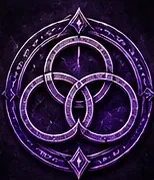
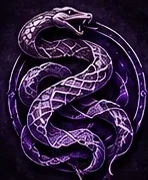


An eighth glyph, a serpent swallowing its own tail, turns up in some older carvings. It belongs to the Ouroboran Heresy and is not counted.
Sacred Numbers and Colors
Numbers
- Three is the number of the Turns, and therefore of the Coil itself. Taps are given in threes; the Chant is called three times.
- Seven is the number of the Tenets, the Minor Crimes, and the Hissing Kings. It is the number of completeness, and of things to be counted.
- Twelve is the number of the current volume of the Ledger and is regarded with nervous anticipation, since the thirteenth volume is a sign of the Unwrapping.
- Ten thousand is the number of years between Sheddings, and is used by the faithful to mean "a very long time," as in, "the healer has been drinking for ten thousand years."
Colors
- Green, the color of scales, worn by all faithful.
- Gold, the color of the Shedfall Scale, worn only by the Inner Scale and the Orders.
- Black, the color of the Void, worn at Banishments, and by anyone who wants to look mysterious at a gathering.